
Top 2 Consumer Electronics Battery Makers End 4-Year Global Litigation in Settlement Mediated by Chinese Court

May 31, 2026
On Wednesday, Zhuhai CosMX Battery Co., Ltd. (688772.SH, “CosMX”) announced in a litigation settlement statement that, through court mediation in relevant jurisdictions, CosMX and Ningde Amperex Technology Co., Limited (“ATL”) reached a settlement after multiple rounds of negotiations and will withdraw all lawsuits worldwide.
ATL is the world’s largest consumer electronics battery manufacturer, while CosMX has grown rapidly in recent years and ranks second. However, the statement did not specify which court mediated the settlement.
Background
ATL was founded in 1999 by Robin Zeng—the founder of CATL. It is one of China’s earliest lithium battery manufacturers. Its customers include major consumer electronics companies such as Apple, Samsung, Huawei, and Xiaomi.
CosMX went public in 2021 (IPO) and grew rapidly, soon threatening ATL’s leading position in the industry. Accordingly, in June 2021, ATL sent CosMX cease-and-desist letters alleging infringement of Chinese and U.S. patents, and in December 2021 filed a patent infringement lawsuit against CosMX with the Fuzhou Intermediate People’s Court (PRIP Wechat, Jan 17, 2022).
Over the following years, ATL remained the primary party initiating litigation. The battle spread from China to the United States and then to Germany, where ATL secured victories in all three jurisdictions, obtaining damages awards and a German injunction. Yet these successes did not lead to a settlement between the parties. Instead, during this period, CosMX continued to file new patent applications, preparing for a later counterattack (PRIP Wechat, Mar 31, 2025).
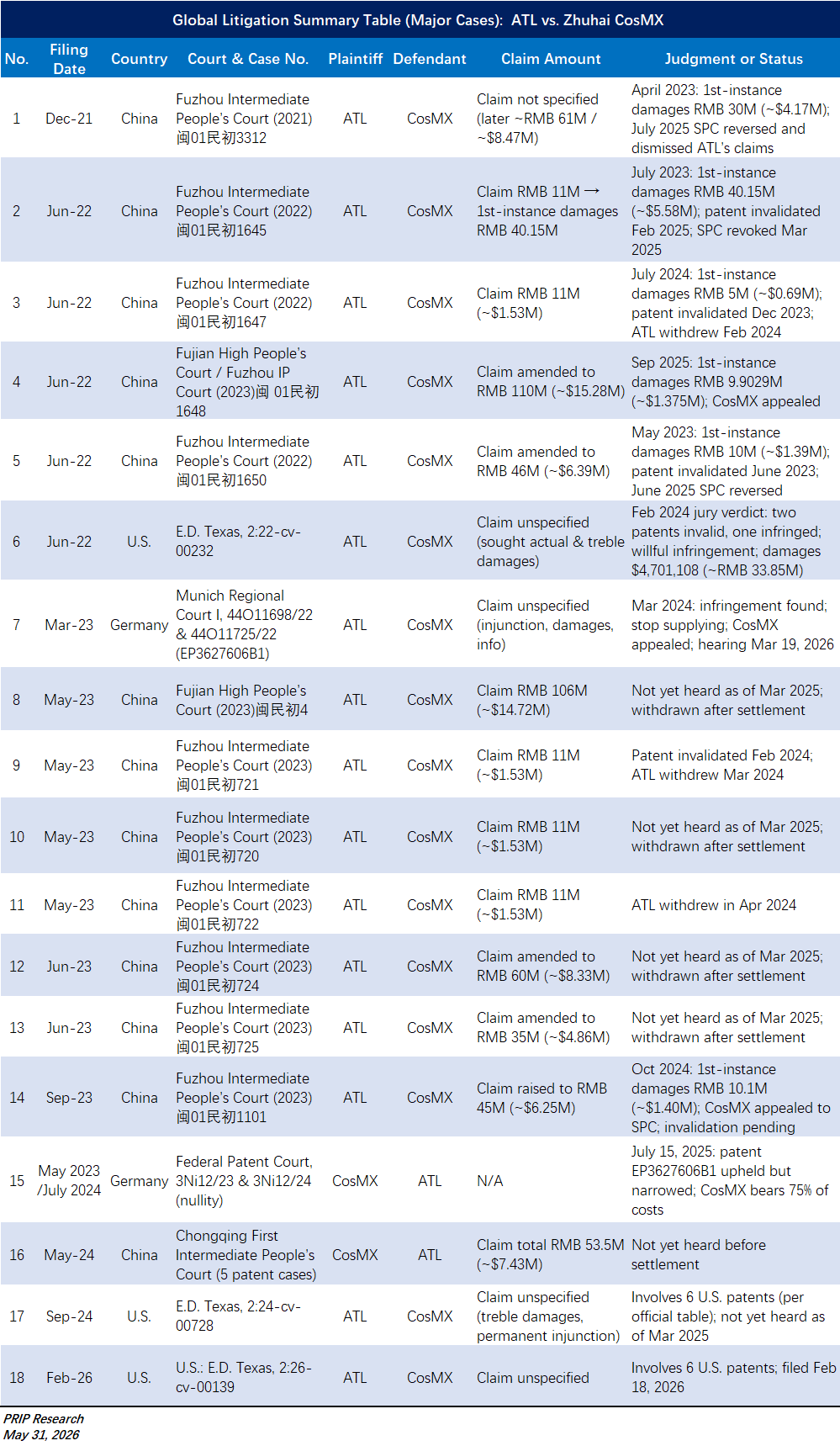
Jurisdiction and Courts
Starting in 2024, CosMX, which had been on the defensive, also began to take the offensive. After years of patent applications and using the lithium-ion battery patents obtained from Panasonic when joining Tulip (PRIP Substack, Oct 13, 2025), it launched a counterattack against ATL (PRIP Substack, Dec 19, 2025). The courts involved in the litigation between the two parties in China include those in Fuzhou, Beijing, Guangzhou, Nanjing, and Chongqing, with some cases appealed to the Supreme People’s Court (PRIP Wechat, July 19, 2025).
In response to CosMX's counterattack, ATL discovered that among the patents used by CosMX, some appeared to have been filed after allegedly misappropriating ATL's trade secrets. As a result, ATL filed new lawsuits this year involving trade secrets and patent ownership disputes, also pointing to issues regarding "copycat patents" . (PRIP Wechat, April 14, 2025) Subsequently, CosMX abandoned the disputed patents in the United States (PRIP Substack, Dec 19, 2025).
Additionally, ATL filed two infringement lawsuits against CosMX in the United States (PRIP Wechat, Aug 7, 2022), one of which resulted in a $4.7 million damages award. In the litigation before the Munich Regional Court I (PRIP Wechat, Mar 21, 2023), ATL obtained an injunction, and the German Federal Patent Court subsequently confirmed the validity of the patent (PRIP Substack, July 18,2025).
Why and who mediated?
Although CosMX did not specifically mention which court led the mediation between the two parties in its statement, it is evident that this type of mediation is a common approach used by Chinese courts in handling patent disputes. PRIP also confirmed this through reliable sources.
In many industries in China, there are similar situations where leading companies in the same sector sue each other for patent infringement. Most of these cases go through mediation in China. For instance, the settlement of lawsuits among several Chinese companies in the photovoltaic industry was actually facilitated by mediation. This is also one of the key efforts in China's governance of "anti-involution".