VDP Pool Faces First Challenge as Snap Sues Dolby, Access Advance in UK Court


July 15, 2026
In early July, Access Advance’s VDP patent pool reached a major milestone: Alibaba and Meta became new licensees, with Meta being the second U.S. company to join, following Roku. Meanwhile, Zhejiang Dahua, after resolving a dispute with Access Advance, also joined the pool as a VDP licensor, bringing the total number of new licensors added in the first half of 2026 to 12. Prior to that, Access Advance announced the patent list for the VDP Pool. PRIP conducted an analysis of this patent list (Substack, June 27, 2026).
According to an announcement by Access Advance on March 24, 2026, Dolby Laboratories Inc., a VDP licensor, has filed suit against Snap Inc. in the United States and Brazil, alleging infringement of patents related to the AV1 and HEVC video codecs. This marks both the first assertion of a patent accusing an AV1 implementation by an Access Advance licensor, and the first AV1 assertion against a streaming platform.
The UK court has released the latest developments in the case: Snap has filed lawsuits against Dolby as well as Access Advance last Friday. PRIP has confirmed that the litigation is not for Access Advance's hardware patent pool, but rather against the VDP patent pool, marking the first time that the VDP pool rules or license fees have appeared as a target in litigation since its launch last year. Case Number: HP-2026-000026. Winston Taylor International LLP is the law firm representing Snap.
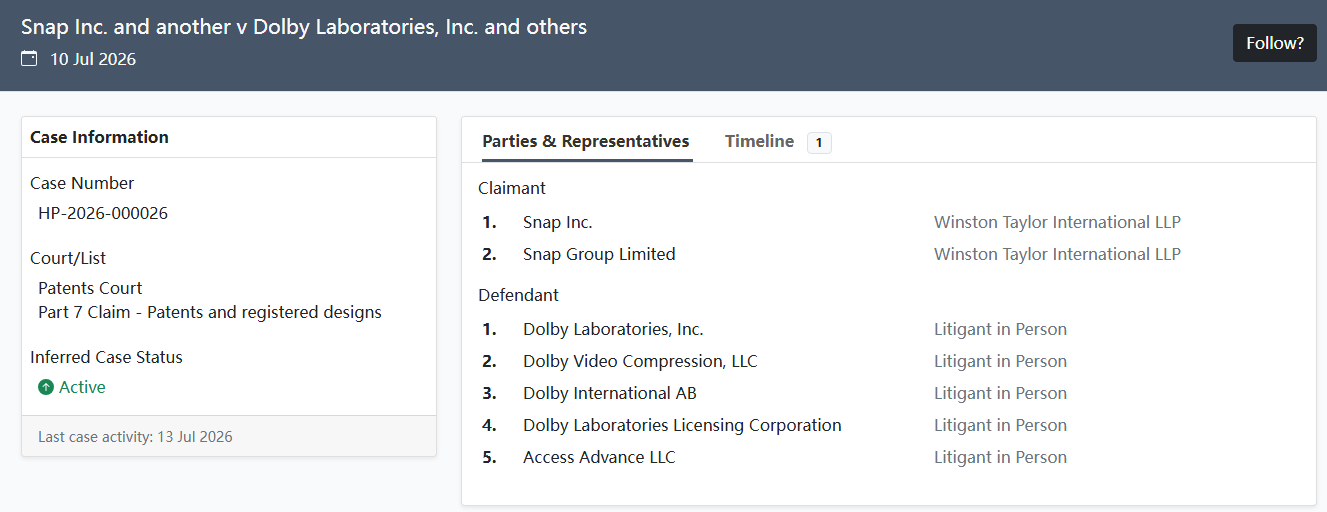
Since UK court tend to be open to ruling on FRAND rates and interim license terms, Snap could try to get the court to set the FRAND rates. What will be interesting to see is whether Snap will seek a rate just for AV1, or a rate covering the whole VDP pool.
Prior to this, Access Advance has already been a defendant in multiple cases. Turkish company Vestel sued Access Advance and secured a victory in a German court, prompting Access Advance to revise its rules. Subsequently, both Zhejiang Dahua and Roku have filed lawsuits against Access Advance. In the Dahua v. Access Advance case, China's Supreme People's Court affirmed that Chinese courts have jurisdiction to determine patent pool FRAND rates. In the Roku v. Access Advance case, the U.S. District Court for the District of Massachusetts rejected Roku's request for the court to set a global FRAND rate, holding that U.S. courts lack jurisdiction over such matters. However, these cases all involved the HEVC hardware patent pool. When Roku filed its lawsuit in December 2024, the VDP patent pool had not yet been established.
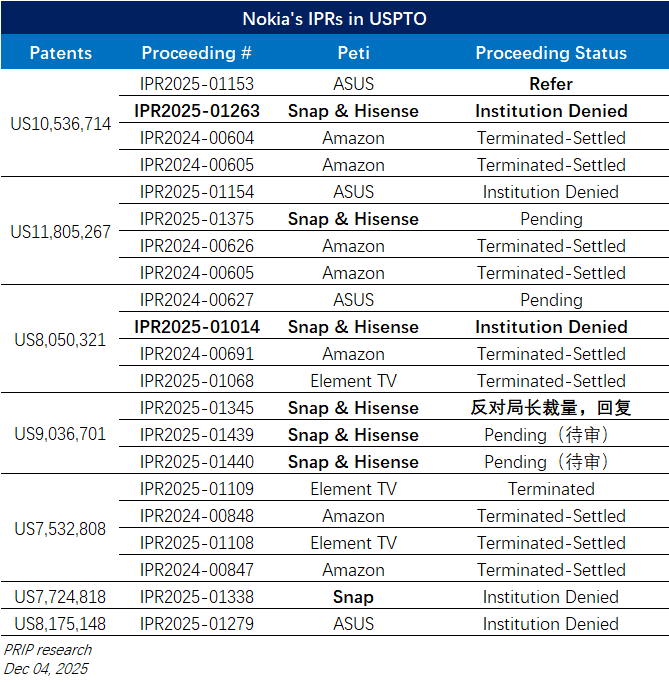
In January, Nokia’s newly appointed Chief Licensing Officer, Tejas Shah, announced on his blog that Snap had signed a license with Nokia, bringing Nokia’s total number of bilateral license agreements with streaming platforms to seven (Substack, Jan 14,2026). Nokia has not sued Snap. On the contrary, Snap, together with Hisense, has been filing IPR petitions with the PTAB against multiple of Nokia's video codec patents. However, multiple IPR petitions have been denied institution by the USPTO.