VDP Pool Patent Landscape

June 27, 2026
On Friday, Access Advance LLC announced the patent list for its Video Distribution Patent (”VDP”) Pool. This is the first patent list published to date specifically for streaming licensing, as Avanci Video, InterDigital, and Nokia have not yet released their patent lists. Therefore, this first published patent list enables research into which patents are specifically directed to streaming platforms and their relationship to patents in the HEVC/VVC hardware patent pools.
Due to the large number of patents, PRIP has conducted a simple analysis with the assistance of AI tools. Some data have been verified, while others have not been carefully cross-checked. Therefore, the following data results cannot be guaranteed to be free from AI hallucinations.
Key Comparisons at a Glance
HEVC: VDP holds 12,895 patents (43.9% of HEVC Advance) and 7,020 encoder patents (54.2% of HEVC Advance’s encoder total). Dolby is the top contributor (4,702). Most licensors transferred fully. M&K, Siemens, SK Planet are VDP‑only. LG, Huawei, Panasonic, Sun Patent Trust are in Avanci Video but not VDP. Samsung (largest HEVC holder) is in neither pool, key future player.
VVC: VDP has 88.5% of VVC Advance’s encoder patents (2,289 vs. 2,587). Most top VVC Advance licensors are in VDP except Sun Patent Trust, Panasonic (both in Avanci Video), and Toshiba (outside pool). ByteDance and Kuaishou are strong VDP VVC licensors. OPPO is new to VDP (not in VVC Advance).
AV1/VP9: Small numbers, 464 AV1 (17 licensors) and 132 VP9 (13 licensors). Encoder patents are minimal (22 and 11). DOCOMO’s 195 AV1 patents are all decoders.
VDP HEVC (Streaming) vs. HEVC Advance (Hardware)
VDP Pool has 41 licensors total for HEVC, VVC, AV1, and VP9. Before the list was released, no one knows how many belonged to each codec. After the list, HEVC turns out to have the largest patent share, covering roughly 28 licensors.
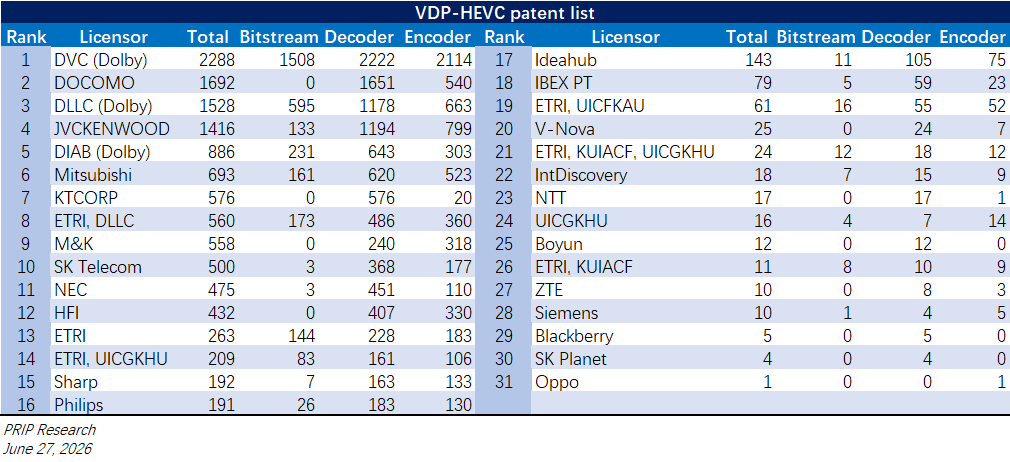
The VDP pool contains 12,895 HEVC patents. Among them, 7,020 are encoder patents related to streaming, while the number of decoder patents remains the largest among the three categories, totaling 11,114. Dolby's three entities—DAC, DLLC, and DIAB—together hold 4,702 patents, making up the largest portion. Dolby has transferred all of its HEVC patents from the HEVC Advance pool to the VDP pool.
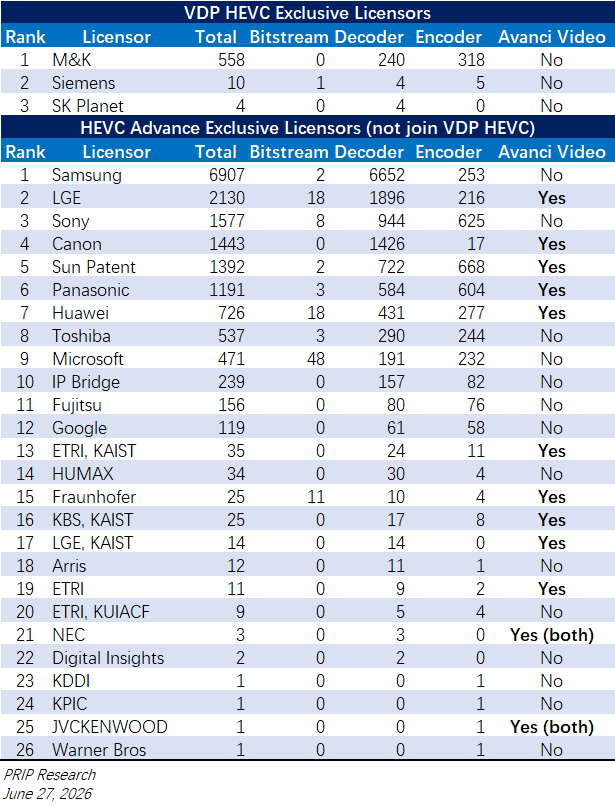
Since The VDP patent list and the HEVC Advance patent lists have the same update date, April 1, 2026, a comparison of the two datasets reveals that the majority of VDP HEVC licensors have fully transferred all of their HEVC Advance patents to the VDP pool, with only very few exceptions, such as ETRI, which has fewer encoder patents in the VDP (183) compared to those in the HEVC Advance pool (192).
Out of 29,394 HEVC patents in the HEVC Advance pool (12,954 of which are encoder patents), the VDP pool has 12,895 HEVC patents and 7,020 encoder patents, representing 43.9% and 54.2% respectively, which means the VDP pool currently provides roughly half of the streaming encoder patents compared to its hardware counterpart, with the remainder likely held by Avanci Video licensors or licensors outside the pools.
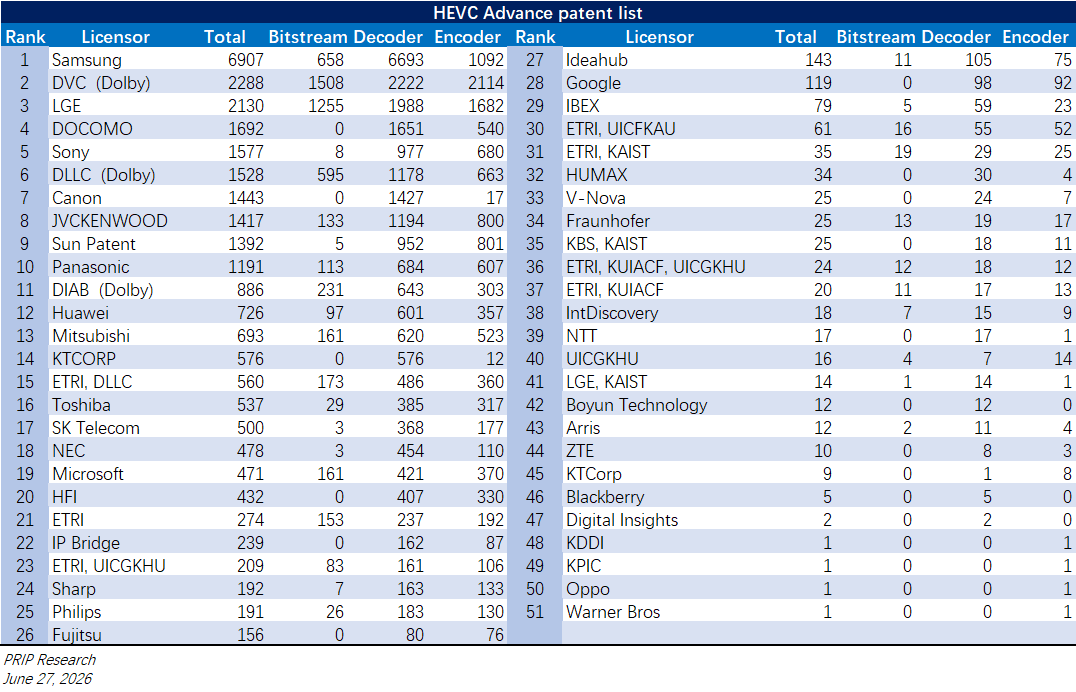
PRIP also identified three HEVC licensors that appear only in the VDP pool: M&K, Siemens, and SK Planet. These three have not joined the Avanci Video pool. In addition, PRIP compiled a list of HEVC licensors that are present in the HEVC Advance pool but not in the VDP pool, which includes some licensors that belong to the Avanci Video pool, such as LG, Huawei, Panasonic, Sun Patent Trust, and others.
Samsung, as the largest HEVC patent holder, has not yet joined either the VDP pool or the Avanci Video pool. However, most other major patent holders have already joined one or both of these pools. Therefore, Samsung's decision may be a key factor going forward.
VDP VVC (Streaming) vs. VVC Advance (Hardware)
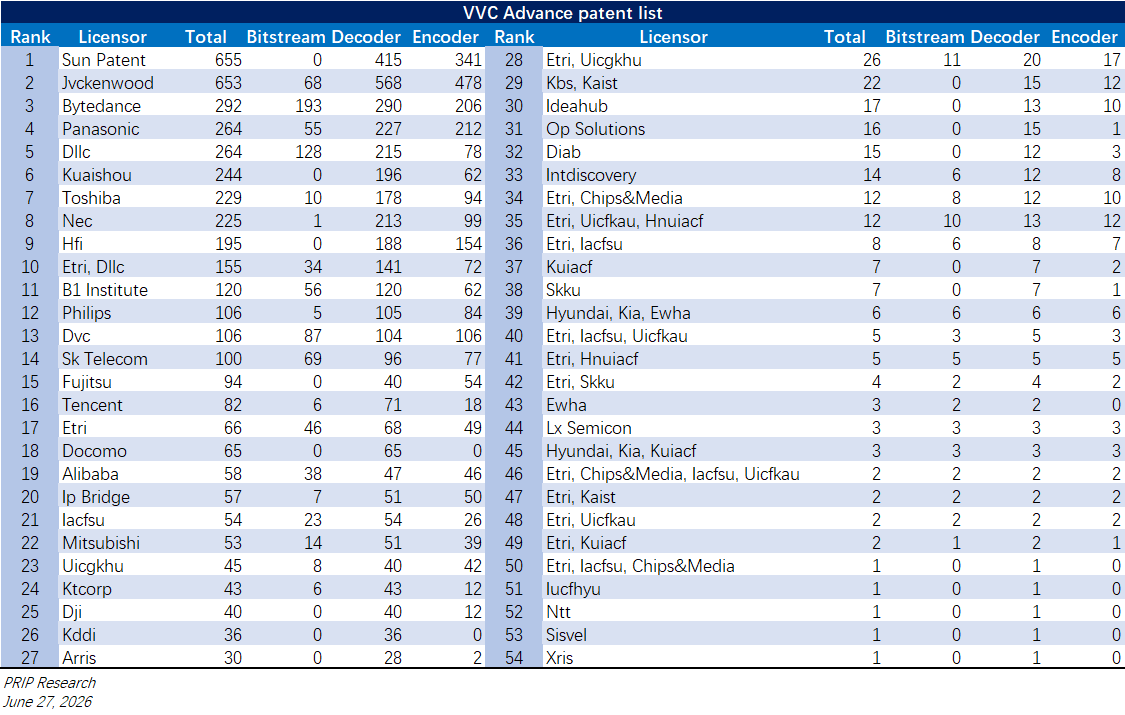
A comparison of the data for VDP VVC and VVC Advance shows that VDP has a better concentration of patents in VVC than in HEVC. This means that most of the VVC Advance patents and the majority of its licensors have already been included in the VDP pool. (The VVC Advance patent list was published in October 2025.)

VDP VVC contains 2,289 encoder patents, while VVC Advance contains 2,587 encoder patents. This means that approximately 88.5% of the encoder patents are already included in the VDP pool. VDP performs better in VVC, which means that the VVC patents in the Avanci Video pool would be relatively weaker.
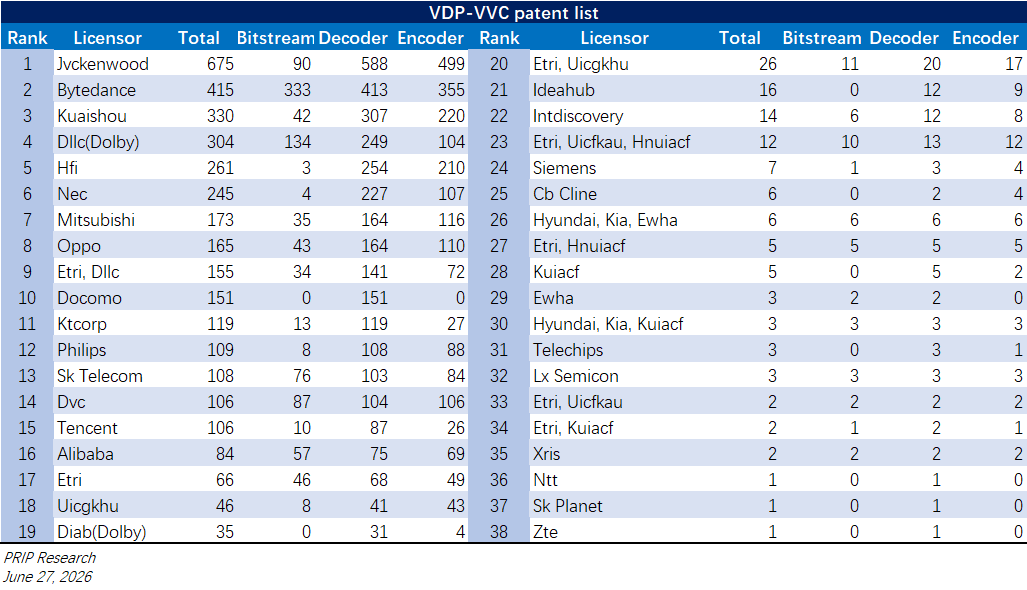
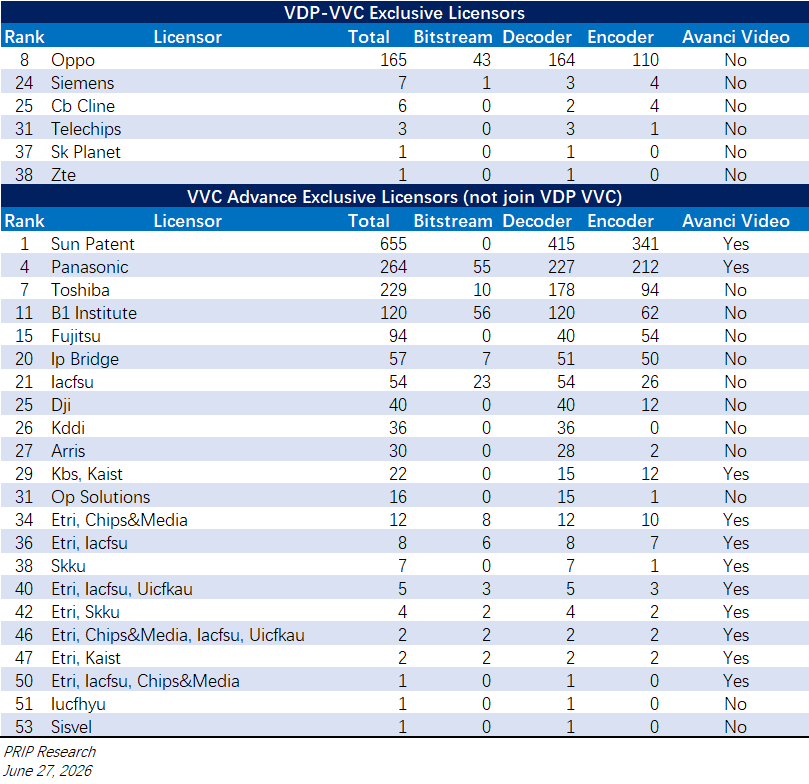
In the VVC Advance top 10, aside from Sun Patent Trust and Panasonic (both in the Avanci Video pool) and Toshiba (not yet in any pool), all other licensors are already in the VDP pool. Moreover, Chinese firms are strong in VVC. ByteDance and Kuaishou are leading licensors in the VDP pool.
OPPO has the most patents among the new VVC licensors in the VDP pool, but its main emphasis is on the VDP pool, and it is not a member of VVC Advance.
VDP AV1 & VP9
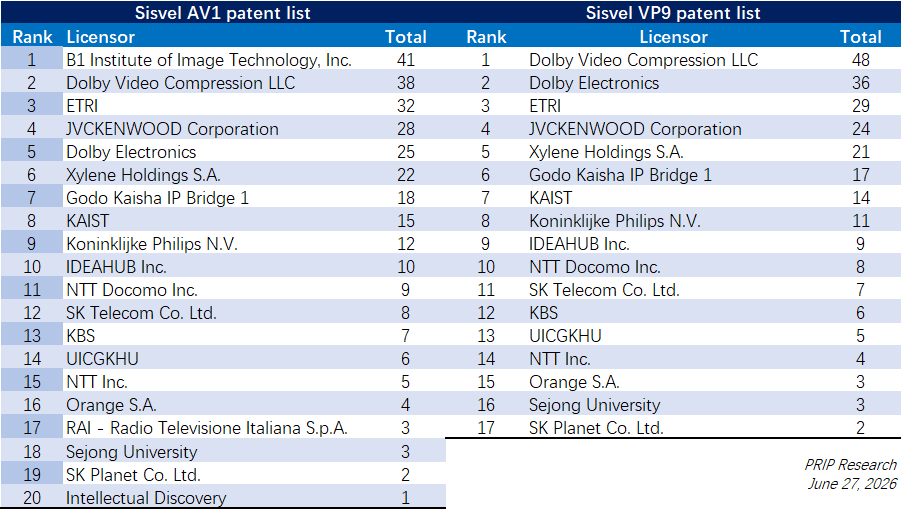
The VDP pool has relatively few AV1 and VP9 patents, with 464 unique AV1 patents from 17 licensors and 132 unique VP9 patents from 13 licensors. However, the number of encoder patents among them is very small, only 22 for AV1 and 11 for VP9. For example, DOCOMO's 195 AV1 patents are all decoder patents.
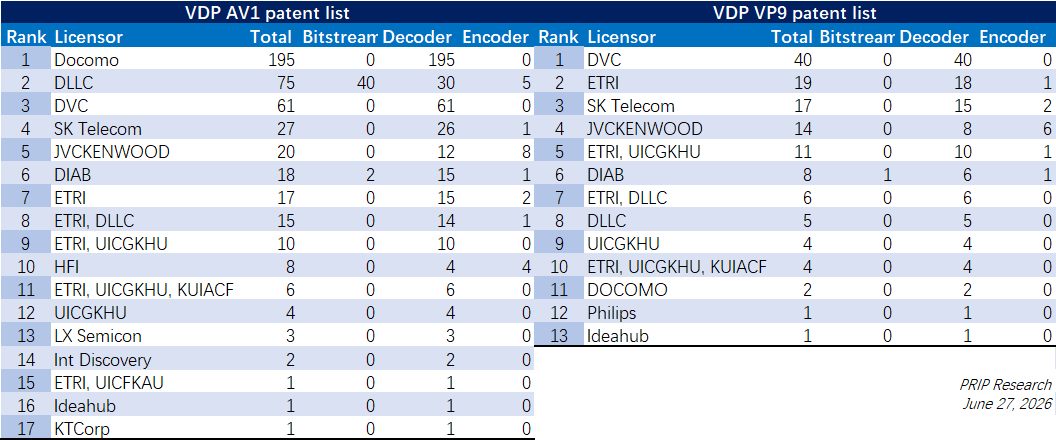
Currently, the only patent pool that can be directly compared with VDP's AV1 and VP9 portfolios is Sisvel, which has published its own AV1 and VP9 patent lists. PRIP has also conducted a statistical analysis of those lists. But Sisvel’s pools are aimed at hardware makers.. The patent at issue in the Dolby v. TPV case previously reported by PRIP, EP2721819, is not only in Sisvel's AV1 pool but also in the VDP pool's AV1 portfolio.